
In Part 1 we gained a little historical perspective of our condo fees. Most importantly, we learned that our fees have always been calculated by a pro rata method per requirement of the Master Deed. This method necessitates that our expenses be multiplied by an apportioning operative (Ownership Factor), the product being the fee to be charged to each condo. We are going to walk through some of the calculations to see how our fees have been evaluated up until a few years ago. We will then look at how our fees have been corrupted with a methodology that is contrary to the pro rata process.
We will begin by assembling data needed to compute the Ownership Factors. Ownership Factors are simply the fractions representing the percentage ownership of each condo in River Oaks Trace. You may remember the following formula from Part 1:

Our job is to gather up the square footage areas of all the condos in ROT. We will do this by way of a spreadsheet the same way Bill Pryor did back in 2005. I will present you with a single spreadsheet one or two columns at a time. Click on Exhibit 1 below. In Column A you will see the condo numbers ordered from #1 to #52. In Column B are the square foot areas of the corresponding condos (on the same row) in Column A. These are the same areas used by Bill Pryor (and approved by the Board of Directors) in 2005, except for condo #52 which was added years later. In all likelihood Pryor used data obtained from the Tax Assessor’s office–possibly from the website www.arcountydata.com which the Assessor uses to publish such information to the public. This site went online around 2003.
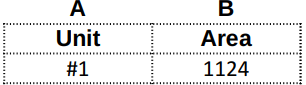
Using the formula for the Ownership Factor given above we can calculate the OF for each condo. You will notice the figure 68,296 at the bottom of Column B; this is the total area of all the condos in the Trace given in square feet. We will calculate the OF for Condo #1 to illustrate:

Don’t be alarmed at the long stream of decimal places; three or four decimal places are enough. It is just that the spreadsheet defaults to such extreme precision. If you click on Exhibit 2, you will see all the other Ownership Factors have been computed in like manner and displayed in Column D. Added in Column E are the equivalent percentages for a more familiar look. Keep in mind that OF’s can change only if the square foot area changes in the Trace.

Turning now to how fees are actually computed, all that needs done is to multiply the amount of Association’s expenses for a given period by the Ownership Factor. The expenses could be the total for a day, a month, or a year–any period, actually. Using Condo #1 as an example, if the Association’s expenses are estimated to be $120,000 for next year, the total fee for Condo #1 would be $120,000 x 0.0164577720510718 = $1,974.93. Dividing the result by 12 gives a monthly fee of $164.58, or $165.00 when rounded.
Our current fees are a result of the original calculations of Bill Pryor back in 2005 along with a couple of modifications–a 28% increase in 2008 and a recalculation of OF’s in 2011 when Condo #52 was added. It is with the most recent modifications of our Board of Directors that we encounter a problem. Over the last couple of fee increases and Special Assessments the Board has not applied the pro rata method per the Master Deed; instead, they have simply increased the fees of all condos by equal amounts.
In one case the Board increased all fees by $50 for a total increase of
$50 x 47 (units) =$2,350.00. As we have already discussed, the way this should have been done is to take the total and multiply it by each OF to find the fee increase for each condo. Click on Exhibit 3 and examine Column E to see the increase that individual condos should have paid. The values shown would be rounded to the nearest dollar. Condos which have areas close to the average of 1453 square feet will also have fee increases close to the average of $50; the variation will be only a few dollars. The difference in fees grows as the condos get smaller or larger. There is a very identifiable bias favorable to larger condos and detrimental toward smaller condos when fees increase. This bias reverses and favors smaller condos when there is a reduction in fees; but, how often are fees ever reduced?

Let’s make a distinction here between the pro rata method stipulated by the Master Deed and the method used by the Board in the most recent fee actions. Hereafter, I will refer to the method of applying equal charges to fees and Special Assessments as “The Levelized Method”, or simply “Levelization”. Be mindful that these two methods are not compatible; in fact, they are mutually destructive. Look at the formula below:

If we divide both sides of this equation by “Total Expense”, we get:
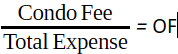
This is exactly what we would expect–the value of the OF (Ownership Factor) remains the same. If we now increase our expense by $50 with a corresponding increase of $50 in the Condo Fee (Levelization) to offset the new expense, we get the following:

If you remember your work with fractions from early school years, you will note that this last expression no longer equals the OF. That, of course, is because when you add the same number to both the numerator and denominator of a fraction, you change the value of the fraction. Remember, we stated earlier that the only way the Ownership Factor could change is for the Area (square footage) of the infrastructure to change as square footage is the metric used to compute the OF’s in the first place. Thus, the Levelized Method corrupts the OF by changing its value.
We have seen how a $50 increase in fees would look by the pro rata method; a $50 Special Assessment would look the same for its duration. Let us now look a case where the Special Assessment is much larger. Last year we repaid two loans in the amount of $83,472.00. The Board simply divided this amount by the number of units in ROT (47) to arrive at a charge of $1,776.00 to be paid by each unit. The way this should have been done, of course, was to multiply the total amount by each Ownership Factor to secure the proportionate amount each condo should have paid. Click on Exhibit 4 and examine Column F to see what the payments should have been.
Condos with areas close to the average (1,453 square feet) paid an amount close to the average of $1,776.00. Payment amounts would vary significantly as the condos get smaller or larger. For perspective, the smallest condo (#34A) paid $649.00 more than it should have paid; the largest condo (#6) paid $1,865.00 less than it should have paid.

In Exhibit 5 the variance between what each condo should have paid and the average of $1,776.00 is shown in Column H. Amounts that were underpaid are shown in red; overpaid amounts are in black. In Column G are our current fees which are now an illegitimate hybrid of the pro rata Method and Levelization.

A few weeks ago I sent a text to the Board of Directors asking why they ignored the Master Deed in assigning the most recent fee increases and Special Assessments (prorating increases). They refused to answer my question. Their silence prompts another question–“Does the Board intend to continue ignoring the Master Deed in the future’? And, of course, the cliche‘ query comes to mind–“If the Board is not going to follow the rules, how can they expect us (members) to follow the rules”?
In Part 3 I will show a simple way to correct the aforementioned irregularities such that the Association has the money it needs to operate and members never overpay nor underpay their fees…mm