Condo Fees…Part 4

Right now the Board must return to compliance to the Master Deed by applying the pro rata method to our current fees. Fortunately, this is probably the simplest and quickest correction to make. The total of our monthly fees is $13,909.00; presumptively, this is also the total of our monthly expenses. All we have to do is to take this total and multiply it by each Ownership Factor (OF) to find the corrected monthly fee for each condo (click on Exhibit 1 to view the new fees in Column F). Doing this by spreadsheet takes only about three seconds. Note that Column G is the new monthly fee (Column F) rounded to the nearest dollar. The sum of fees in Column G differs from the sum in Column F by a couple of dollars due to rounding errors.
We have simply moved dollars around so that each condo is now paying the correct proportion of expense according to the OF’s.

Exhibit 1

I will now explain something that I brought up in Part 1. I stated that Bill Pryor made a decision that had a negative impact on our fee collection from 2005 until the present. His decision was to project the expenses for the coming year; that is, he attempted to estimate the expenses we would face over the next twelve months–to predict the future. Almost everybody would have done the same given the task of calculating our fees. Let me note here that the Master Deed and the By-Laws are neutral as to whether actual expenses or estimated expenses are to be used to determine fees. This is what corporations, governments, and businesses do; they project ahead, albeit with margins of error. We, however, are just a tiny condominium association with relatively meager resources and projecting ahead carries a significant risk of uncertainty. The fact is that one cannot predict the future; but one can predict the past with 100% accuracy. I will further note that there is no provision in the Master Deed or By-Laws for collecting fees beyond what is needed to satisfy our expenses.

What I am saying is that it makes little sense to estimate expenses for such a small organization–there is no need to do that. We personally pay bills like water, gas, electricity, credit cards, etc. at the end of the month for services received during that month. Many HOA’s pay their bills that way; so can we.

Let me give you an idea of how such a system would work:
1) We would first need to establish an operating fund . I recommend starting with the 2025 average expense of $12,000.00 and adding 50% for a total of $18,000.00. This should be more than enough for typical month-to-month operating costs.
2) At the end of the month our Treasurer would total up the money spent during that month. That total would be the basis for condo fees. Just as we have already outlined, the Treasurer would multiply that total by the Ownership Factors to determine each fee.
3) The Treasurer would then send members itemized statements to be paid.

The method described above accomplishes two important things:
1) Members pay exactly the amount of expenses, no more and no less. The operating fund is refunded the same amount paid out. Members are neither overcharged nor undercharged and will keep their money that would have been excess otherwise.
2) There will be no more inflated fee increases. Costs may increase, but any increase will be automatically paid with each fee billing–in other words, increases (and decreases) are built in.

By the way, above I stated that the Treasurer would send out itemized statements for condo fees. Did you know that we (members) are entitled to such itemized statements? We have the right to know what we are paying for; in fact, it is stated in the By-Laws in Article V, Sec. 5e. You can read this section in Exhibit 2 below. Implied in the highlighted portion is the fee collection method described above; that is, in order to create an itemized statement, expenses must be quantified according to type and measure.
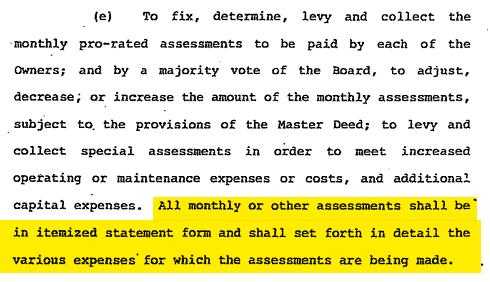
Exhibit 2

In order to discuss the above method of fee collection, I will give it a name–the Direct Pay method. Direct Pay is the process of paying for goods and services (from the operating fund) and then billing that exact amount to members after pro rating the total at the end of the month to determine each condo’s proportionate fee.

Let me now give you an example of how Direct Pay would have looked if my personal fee had been calculated and billed for the last twelve months using the actual values of expenses from July 2025 through the end of June 2026. My fee during those months was $285.00/mo. I will show you what my fee would have been each month with Direct Pay. Column D in Exhibit 3 below shows what I would have paid under Direct Pay.
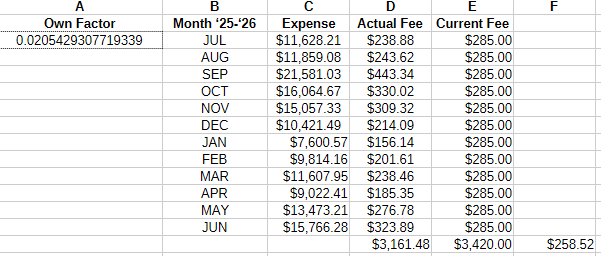
Exhibit 3

As you can see in the table of Exhibit 3, most of my monthly payments (Column D) fall below my current fee of $285.00 (Column E); only a few rise above it. If you compare the totals, you will see that I save $258.00 (Column F). Under Direct Pay the Association has all the money it needs to operate. Special projects, reserves, and refunding operations can be funded by Special Assessments tacked on to each monthly fee after being amortized over a suitable period. The Association can have all the money it needs to accomplish its legitimate goals, but no more; after all, we have to pay our expenses. Members get to keep their money which would otherwise wind up as excess.

I can immediately see objections coming from the Board of Directors. Going to Direct Pay will probably seem to them to be risky. This is nonsense. There are a number of fail-safes to protect us–the operating fund is flexible and can be increased or decreased, a reserve established, and a line of credit available at all times. Most importantly, let us consider what happened last year; our members did an extraordinary thing in paying back a large amount in loans (over $83,000.00) in just 12 months. It is this resourcefulness and capability of our members that should help the Board get beyond its pearl clutching and mature to the point of acceptance. We have proven that we can overcome as stiff a challenge as we are likely to meet.

The foregoing argument is not an opinion nor a suggestion; it is an imperative. The Board needs to adopt the Direct Pay method to bring order and efficiency to our fee collection. How can trying to predict the future stand up to the unavoidable logic of Direct Pay? We need to abandon the sloppy, inefficient, and confiscatory method of the past in fairness to our members…mm

Posted in Uncategorized | Leave a comment

Condo Fees…Part 3

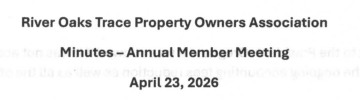
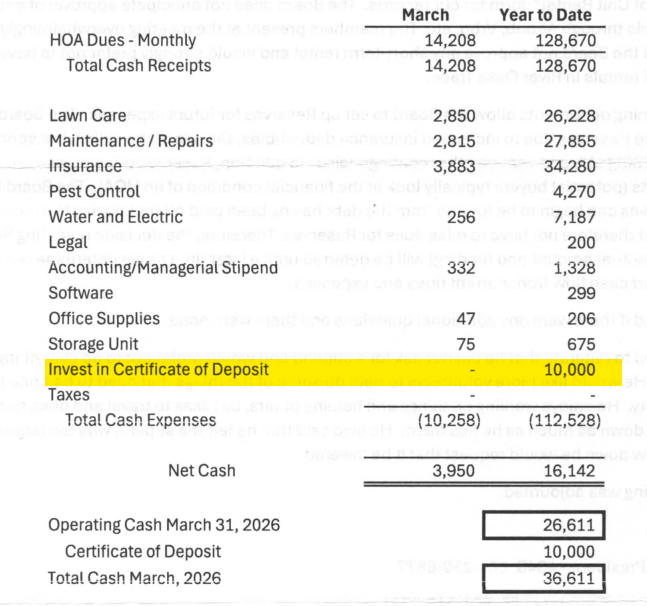
This post was originally supposed to be about another facet of our Board’s fee collection practice; however, I thought it more important to relate to you some things which I have recently learned. Look at Exhibit 1 below, particularly the entry highlighted in yellow. Exhibit 1 is a snapshot of the finance report given in the Minutes of our Annual Meeting held in March this year. This entry immediately prompted a question in my mind–“Where did we get ten thousand extra dollars to invest in a certificate of deposit (CD)”? This money would be tied up for several months and unavailable to spend on expenses until the CD matured. It is clear that this money was excess and the Board considered it a good idea to invest it.

Exhibit 1

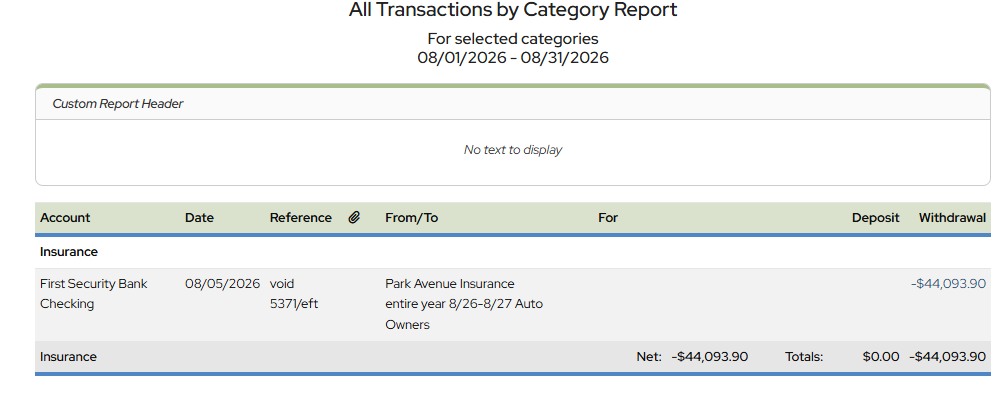
Today I learned that we have paid our entire year’s premium for the insurance policy that we have with Auto-Owner’s Insurance. Our policy is handled through Park Avenue Insurance and I confirmed with their office that we paid the whole year’s premium in the amount of $44,043.90. I found this intriguing and again had to ask myself where we found $44,000 with which to make such a payment. Again, as above, the answer must be fee overcharges going back, at least, to the beginning of 2025. Now, the Board may argue that we accumulated the money due to fewer maint/repair projects than usual. This argument holds for short periods of time like 2-3 months; but, when we accumulate money for a year and longer, we may properly call that money excess–beyond the scope of normal operation–and that money should be refunded to members or credited to their accounts.

Exhibit 2

It is extraordinary, to say the least, that we have accrued so much money, over $50,000.00, especially to be paid in such a manner as an entire year’s insurance premium.

Exhibit 3

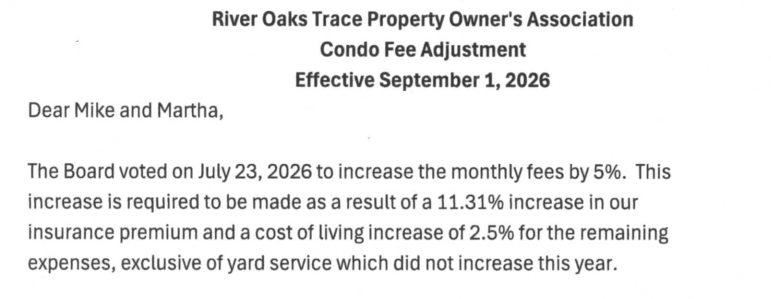
Exhibit 3 is an excerpt from the letter we received recently advising of our most recent fee increase of 5% to go into effect on 1 September. Read the excerpt above carefully and let it sink in. Are we to believe that we need higher fees due to an increased insurance premium now that we have paid our insurance premium for all of the year? Remember, we paid our premium using excess money collected over many months. That liability is now behind us and we will be collecting about $4,000 of revenue per month which would normally have been used to pay our premium–if we were paying it monthly. If, of course, the Board plans to pre-pay future premiums, this money will have to be set aside each month towards that purpose. Given similar circumstances, we will still be overpaying our fees going forward just like we have been for the past 18 months. Perhaps I am just too stupid to understand why we need a fee increase at this time and, perhaps, many of us also don’t understand why.

For the benefit of those of us who can’t comprehend the necessity of the latest fee upgrade, I invite a Board member to come on this venue and present the rationale for it in more detail than is given in their letter–including the arithmetic. It would be greatly appreciated…mm

Posted in Uncategorized | Leave a comment

Minutes…Annual Meeting 2026

Posted in Uncategorized | Leave a comment

Condo Fees…Part 2

In Part 1 we gained a little historical perspective of our condo fees. Most importantly, we learned that our fees have always been calculated by a pro rata method per requirement of the Master Deed. This method necessitates that our expenses be multiplied by an apportioning operative (Ownership Factor), the product being the fee to be charged to each condo. We are going to walk through some of the calculations to see how our fees have been evaluated up until a few years ago. We will then look at how our fees have been corrupted with a methodology that is contrary to the pro rata process.

We will begin by assembling data needed to compute the Ownership Factors. Ownership Factors are simply the fractions representing the percentage ownership of each condo in River Oaks Trace. You may remember the following formula from Part 1:

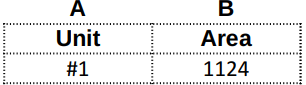
Our job is to gather up the square footage areas of all the condos in ROT. We will do this by way of a spreadsheet the same way Bill Pryor did back in 2005. I will present you with a single spreadsheet one or two columns at a time. Click on Exhibit 1 below. In Column A you will see the condo numbers ordered from #1 to #52. In Column B are the square foot areas of the corresponding condos (on the same row) in Column A. These are the same areas used by Bill Pryor (and approved by the Board of Directors) in 2005, except for condo #52 which was added years later. In all likelihood Pryor used data obtained from the Tax Assessor’s office–possibly from the website www.arcountydata.com which the Assessor uses to publish such information to the public. This site went online around 2003.

Exhibit 1

Using the formula for the Ownership Factor given above we can calculate the OF for each condo. You will notice the figure 68,296 at the bottom of Column B; this is the total area of all the condos in the Trace given in square feet. We will calculate the OF for Condo #1 to illustrate:

Don’t be alarmed at the long stream of decimal places; three or four decimal places are enough. It is just that the spreadsheet defaults to such extreme precision. If you click on Exhibit 2, you will see all the other Ownership Factors have been computed in like manner and displayed in Column D. Added in Column E are the equivalent percentages for a more familiar look. Keep in mind that OF’s can change only if the square foot area changes in the Trace.

Exhibit 2

Turning now to how fees are actually computed, all that needs done is to multiply the amount of Association’s expenses for a given period by the Ownership Factor. The expenses could be the total for a day, a month, or a year–any period, actually. Using Condo #1 as an example, if the Association’s expenses are estimated to be $120,000 for next year, the total fee for Condo #1 would be $120,000 x 0.0164577720510718 = $1,974.93. Dividing the result by 12 gives a monthly fee of $164.58, or $165.00 when rounded.

Our current fees are a result of the original calculations of Bill Pryor back in 2005 along with a couple of modifications–a 28% increase in 2008 and a recalculation of OF’s in 2011 when Condo #52 was added. It is with the most recent modifications of our Board of Directors that we encounter a problem. Over the last couple of fee increases and Special Assessments the Board has not applied the pro rata method per the Master Deed; instead, they have simply increased the fees of all condos by equal amounts.

In one case the Board increased all fees by $50 for a total increase of
$50 x 47 (units) =$2,350.00. As we have already discussed, the way this should have been done is to take the total and multiply it by each OF to find the fee increase for each condo. Click on Exhibit 3 and examine Column E to see the increase that individual condos should have paid. The values shown would be rounded to the nearest dollar. Condos which have areas close to the average of 1453 square feet will also have fee increases close to the average of $50; the variation will be only a few dollars. The difference in fees grows as the condos get smaller or larger. There is a very identifiable bias favorable to larger condos and detrimental toward smaller condos when fees increase. This bias reverses and favors smaller condos when there is a reduction in fees; but, how often are fees ever reduced?

Exhibit 3

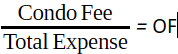
Let’s make a distinction here between the pro rata method stipulated by the Master Deed and the method used by the Board in the most recent fee actions. Hereafter, I will refer to the method of applying equal charges to fees and Special Assessments as “The Levelized Method”, or simply “Levelization”. Be mindful that these two methods are not compatible; in fact, they are mutually destructive. Look at the formula below:

If we divide both sides of this equation by “Total Expense”, we get:

This is exactly what we would expect–the value of the OF (Ownership Factor) remains the same. If we now increase our expense by $50 with a corresponding increase of $50 in the Condo Fee (Levelization) to offset the new expense, we get the following:

If you remember your work with fractions from early school years, you will note that this last expression no longer equals the OF. That, of course, is because when you add the same number to both the numerator and denominator of a fraction, you change the value of the fraction. Remember, we stated earlier that the only way the Ownership Factor could change is for the Area (square footage) of the infrastructure to change as square footage is the metric used to compute the OF’s in the first place. Thus, the Levelized Method corrupts the OF by changing its value.

We have seen how a $50 increase in fees would look by the pro rata method; a $50 Special Assessment would look the same for its duration. Let us now look a case where the Special Assessment is much larger. Last year we repaid two loans in the amount of $83,472.00. The Board simply divided this amount by the number of units in ROT (47) to arrive at a charge of $1,776.00 to be paid by each unit. The way this should have been done, of course, was to multiply the total amount by each Ownership Factor to secure the proportionate amount each condo should have paid. Click on Exhibit 4 and examine Column F to see what the payments should have been.

Condos with areas close to the average (1,453 square feet) paid an amount close to the average of $1,776.00. Payment amounts would vary significantly as the condos get smaller or larger. For perspective, the smallest condo (#34A) paid $649.00 more than it should have paid; the largest condo (#6) paid $1,865.00 less than it should have paid.

Exhibit 4

In Exhibit 5 the variance between what each condo should have paid and the average of $1,776.00 is shown in Column H. Amounts that were underpaid are shown in red; overpaid amounts are in black. In Column G are our current fees which are now an illegitimate hybrid of the pro rata Method and Levelization.

Exhibit 5

A few weeks ago I sent a text to the Board of Directors asking why they ignored the Master Deed in assigning the most recent fee increases and Special Assessments (prorating increases). They refused to answer my question. Their silence prompts another question–“Does the Board intend to continue ignoring the Master Deed in the future’? And, of course, the cliche‘ query comes to mind–“If the Board is not going to follow the rules, how can they expect us (members) to follow the rules”?

In Part 3 I will show a simple way to correct the aforementioned irregularities such that the Association has the money it needs to operate and members never overpay nor underpay their fees…mm

Posted in Uncategorized | Leave a comment

Celebrate

Posted in Uncategorized | Leave a comment

Hoops! Here We Go

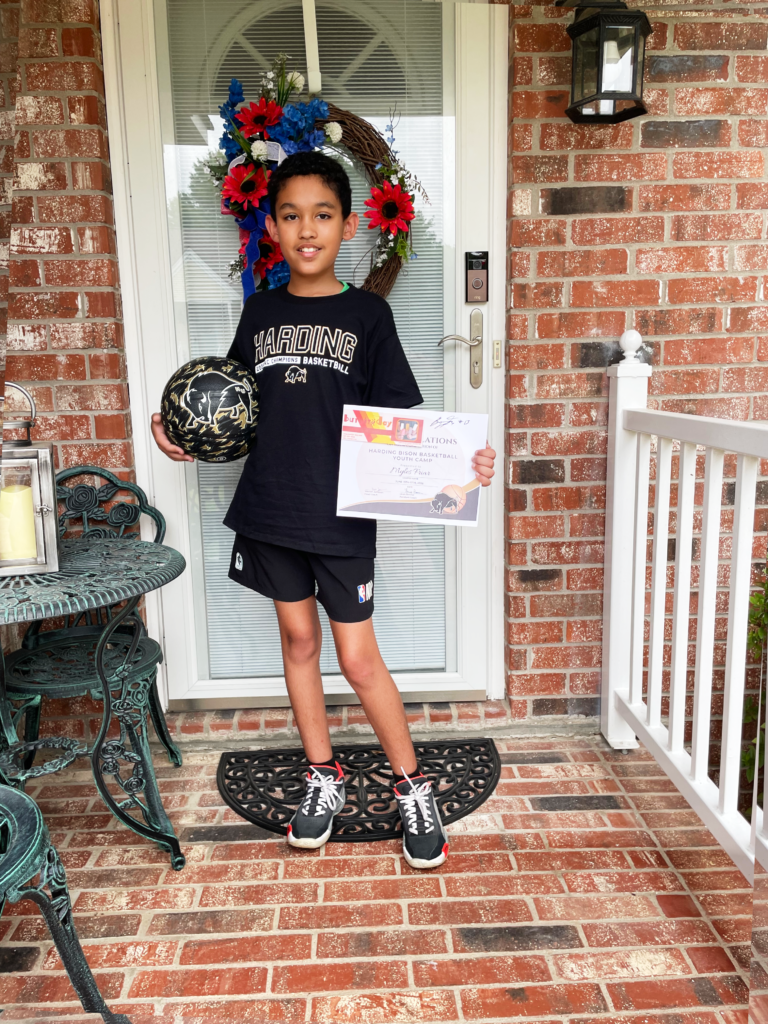
Congrats to Myles F who recently completed basketball camp at Harding University. Myles is son of Carrie and Paul F (#12). Now where is that LeBron guy?

Posted in Uncategorized | Leave a comment

Condo Fees…Part 1

Back in 2005 a man by the name of Bill Pryor was tasked by our Board of Directors with recalculating the condo fees of River Oaks Trace. Bill was the accountant for the Association at the time. He was a sober, competent professional who enjoyed a reputation for dedication and accuracy.

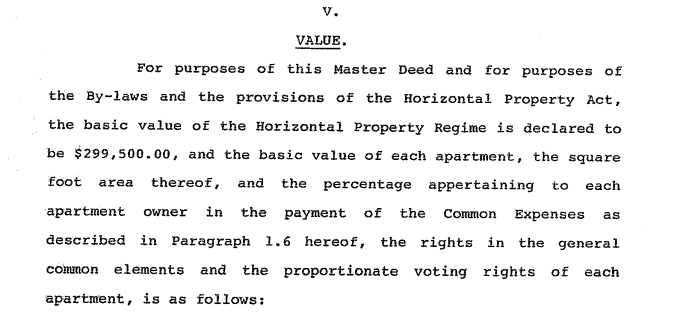
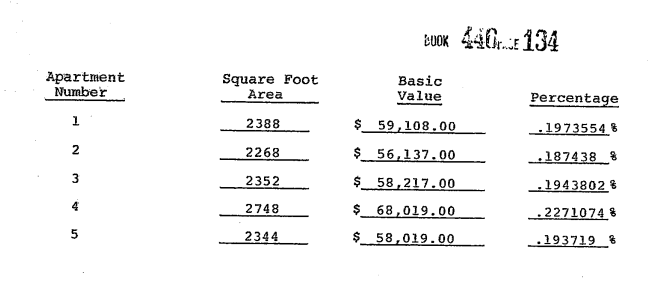
The Association’s Master Deed sets out the guidelines for computing condo fees in clear fashion after stating its philosophy about how they should be created. That philosophy is that since larger condos require more resources for the services they receive, they should pay proportionately higher fees; collaterally, smaller condos require fewer resources for the services they receive and should pay proportionately smaller fees. The fees, therefore, should be distributed in a manner that reflects the size of the condos to which the fees are applied; thus, a pro rata method of distribution should be used in fee calculation. Below is the excerpt from Section V of the Master Deed laying out the pro rata method of fee calculation.

Following the above instruction is an explicit example of the above outlining the method used in computing the percentage ownership of the original condos comprising River Oaks Trace–condos 1 through 5.

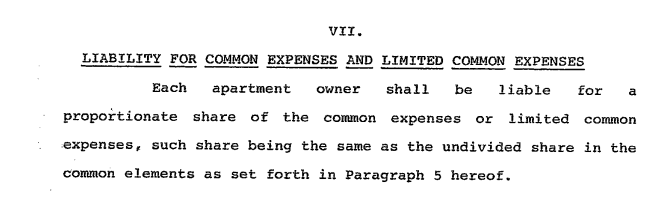
Additionally, Section VII of the Master Deed assigns the payment of the common expenses as being proportionate to the Ownership Factors, or Percentage, as calculated in the above example.

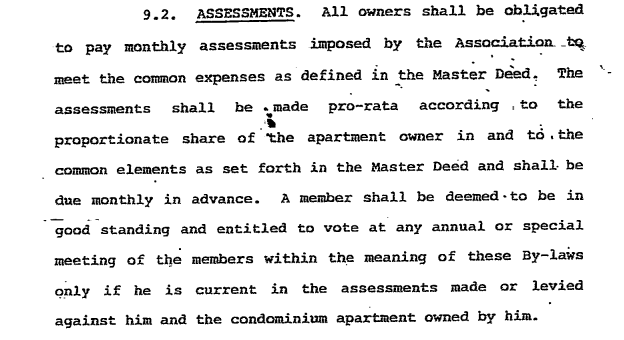
The concept of proportionate share in the payment of common expenses is further reinforced in Section IX, Article 9.2, of the By-Laws:

Let me explain that “size of the condos” means the square foot area of not only the living area but also virtually all appurtenant structures associated with the condos–garages, decks, patios, walkways, etc. Bill Pryor assembled the square footage for each condo in the Trace, likely from such data maintained by the county tax assessor. He could then calculate the fractional share of ownership of each condo by dividing the area of each condo by the total square footage of all condos. Such mathematical division would produce a decimal fraction representing each condo’s share of ownership. This fraction is what I will hereafter call the condo’s “Ownership Factor”. In Part 2 of this series, I will show you the calculations used to determine the Ownership Factors for us currently and then how those factors are used in computing our fees.

Once Bill Pryor had calculated the Ownership Factors he turned to projecting the expense data for the coming year. Some of the expenses were fairly simple to grab–like insurance, lawn care, and termite control; these items are contracted so could be easily predicted, though multipliers may have been applied for cost increases. Not so easy to predict were maintenance/repair costs which could vary tremendously from year to year. Once he concluded a final figure for the expenses for the coming year, he applied the Ownership Factors to this figure to arrive at the yearly fee for each condo. Dividing by 12 then rendered the monthly fee for each condo.

Over the years since Bill’s work there have been a handful of modifications to our condo fees. Just two years after Bill’s efforts the Board at the time determined that we were not bringing in enough revenue and in 2008 a 28% increase was imposed. About 2011 the last condo built in River Oaks Trace (#52) was figured in to the Ownership Factors. Fees were stable for several years after that until we underwent some fee increases and Special Assessments necessitated by natural cost additions and bank loans.

In Part 2 I will take you through the calculations to determine the Ownership Factors; then, we will look at the computations for condo fees. I will show you some anomalies present in our current fees, how our fees have been corrupted, and I will reveal to you the consequential decision made by Bill Pryor back in 2005 that has troubled the collection of condo fees for the past 21 years…mm

Posted in Uncategorized | Leave a comment

Cleaning House

I met an energetic young man yesterday by the name of Jacob Doyle who is working in the neighborhood power washing our houses. He was contracted by President Sivia to clean all the units in River Oaks Trace. I am sure this is good news to all.

Jacob is very accommodating and is careful of details like flowerbeds; be sure to offer your cooperation and instruction when he makes it to your home, probably within the next two weeks or so. Also, give a shout of thanks to President Sivia when you see him.

If you have personal power washing needs, you can call Jacob at 573-239-7205. Click on the image below to go to his website…mm

Posted in Uncategorized | Leave a comment

Huh! We Are Paying Our President?

It was not that surprising to learn at our general meeting that we are compensating our President. Our legacy documents do not allow compensation for the President, other staff, or Board members for performing their regular duties; however, compensation is allowed for work performed above and beyond those duties–typically, work that we would have to pay for anyway like professional services. Traditionally, over the last 40 years or so, any work offered by the President outside their duties was considered voluntary. The job can be demanding and any work outside the job duties is certainly worth compensating.

Out of curiosity I sent a text to the Board of Directors asking about the reportable nature of the compensation. The exchange is given below.

QUESTION: Hon. Board, Now that we are paying our President, I have a question.  Are we paying him under a W-4 (employee), 1099 (contractor), or nothing at all?

BOARD’S RESPONSE: Thank you for your question . The board has made sure that all necessary documentation for Bills stipend has filed. 

My question was simple, pointed and object-oriented and I expected a specific answer. The Board’s response, however, was non-specific and deflective. Curious that they did not just tell me which document applied…mm

Posted in Uncategorized | Leave a comment

Today

Posted in Uncategorized | Leave a comment