
Back in 2005 a man by the name of Bill Pryor was tasked by our Board of Directors with recalculating the condo fees of River Oaks Trace. Bill was the accountant for the Association at the time. He was a sober, competent professional who enjoyed a reputation for dedication and accuracy.
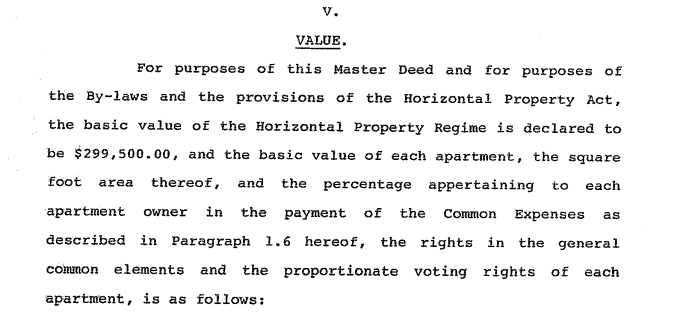
The Association’s Master Deed sets out the guidelines for computing condo fees in clear fashion after stating its philosophy about how they should be created. That philosophy is that since larger condos require more resources for the services they receive, they should pay proportionately higher fees; collaterally, smaller condos require fewer resources for the services they receive and should pay proportionately smaller fees. The fees, therefore, should be distributed in a manner that reflects the size of the condos to which the fees are applied; thus, a pro rata method of distribution should be used in fee calculation. Below is the excerpt from Section V of the Master Deed laying out the pro rata method of fee calculation.
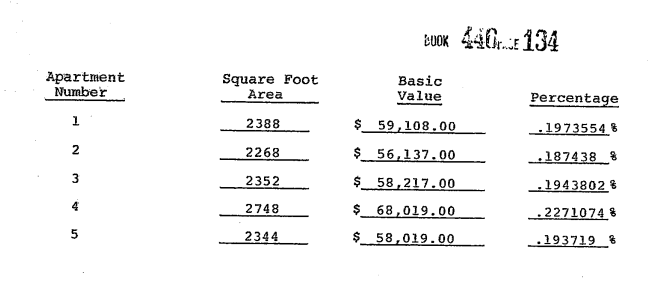
Following the above instruction is an explicit example of the above outlining the method used in computing the percentage ownership of the original condos comprising River Oaks Trace–condos 1 through 5.
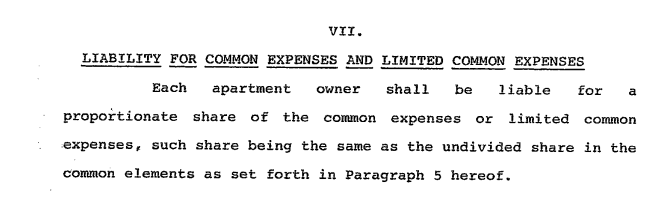
Additionally, Section VII of the Master Deed assigns the payment of the common expenses as being proportionate to the Ownership Factors, or Percentage, as calculated in the above example.
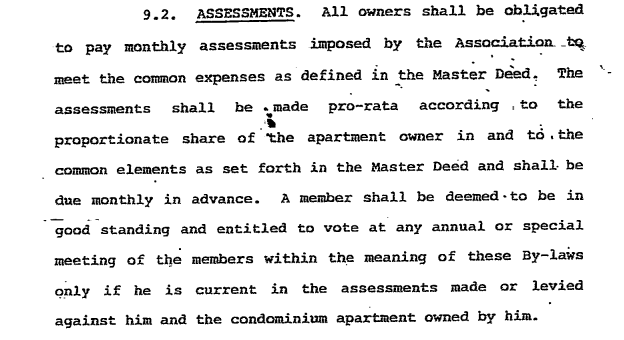
The concept of proportionate share in the payment of common expenses is further reinforced in Section IX, Article 9.2, of the By-Laws:

Let me explain that “size of the condos” means the square foot area of not only the living area but also virtually all appurtenant structures associated with the condos–garages, decks, patios, walkways, etc. Bill Pryor assembled the square footage for each condo in the Trace, likely from such data maintained by the county tax assessor. He could then calculate the fractional share of ownership of each condo by dividing the area of each condo by the total square footage of all condos. Such mathematical division would produce a decimal fraction representing each condo’s share of ownership. This fraction is what I will hereafter call the condo’s “Ownership Factor”. In Part 2 of this series, I will show you the calculations used to determine the Ownership Factors for us currently and then how those factors are used in computing our fees.
Once Bill Pryor had calculated the Ownership Factors he turned to projecting the expense data for the coming year. Some of the expenses were fairly simple to grab–like insurance, lawn care, and termite control; these items are contracted so could be easily predicted, though multipliers may have been applied for cost increases. Not so easy to predict were maintenance/repair costs which could vary tremendously from year to year. Once he concluded a final figure for the expenses for the coming year, he applied the Ownership Factors to this figure to arrive at the yearly fee for each condo. Dividing by 12 then rendered the monthly fee for each condo.

Over the years since Bill’s work there have been a handful of modifications to our condo fees. Just two years after Bill’s efforts the Board at the time determined that we were not bringing in enough revenue and in 2008 a 28% increase was imposed. About 2011 the last condo built in River Oaks Trace (#52) was figured in to the Ownership Factors. Fees were stable for several years after that until we underwent some fee increases and Special Assessments necessitated by natural cost additions and bank loans.
In Part 2 I will take you through the calculations to determine the Ownership Factors; then, we will look at the computations for condo fees. I will show you some anomalies present in our current fees, how our fees have been corrupted, and I will reveal to you the consequential decision made by Bill Pryor back in 2005 that has troubled the collection of condo fees for the past 21 years…mm